
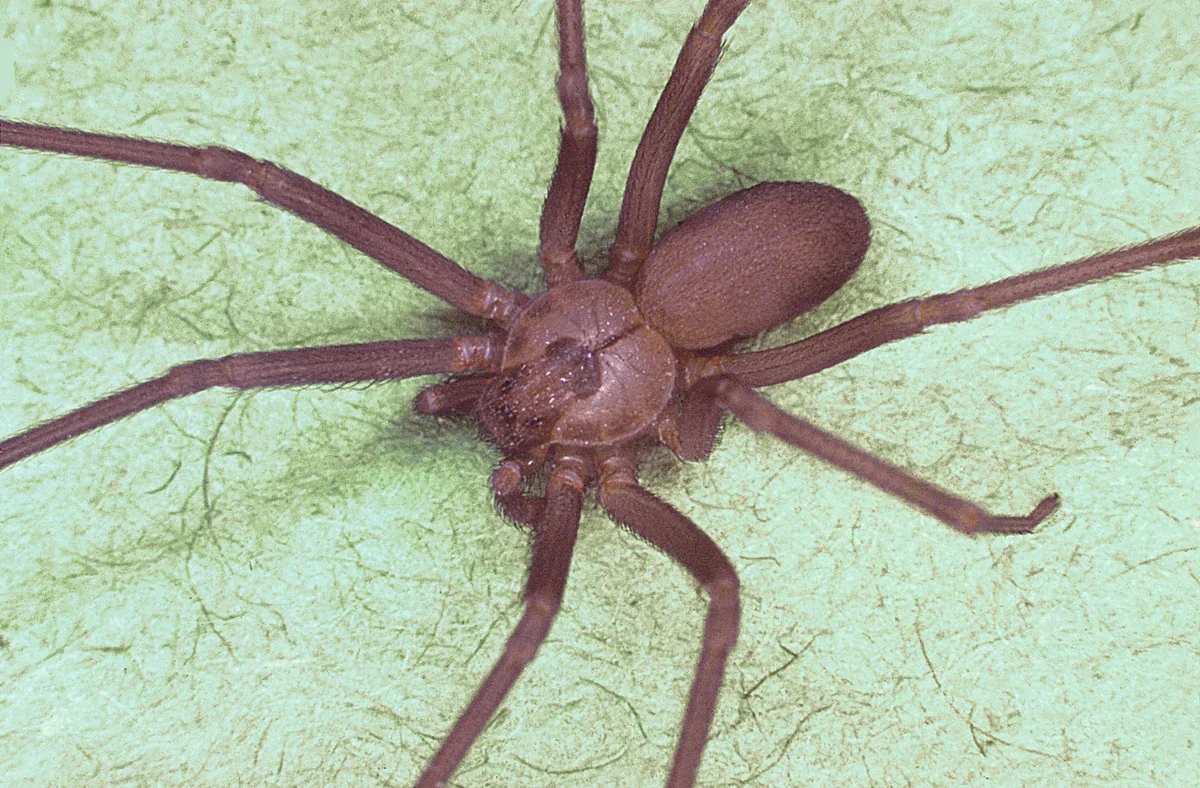
You find a brown spider on the closet floor, and the first question is whether it is a brown recluse. The brown recluse does live in Alabama, but most brown spiders in a Birmingham home turn out to be something harmless. A spider can’t be confirmed as a recluse from a quick look at its color or a violin-like shape, and a skin wound can’t confirm it either. This guide covers the features that actually separate a brown recluse from its look-alikes, where recluses hide indoors, why so many bites are misdiagnosed, and when to see a doctor. It is general homeowner information, not medical advice and not an inspection of your home.
The Short Answer
A spider is only a likely brown recluse if it has all of these:
- Six eyes in three pairs. Most spiders have eight. This is the most reliable sign, but you usually need a magnifying glass or a sharp, zoomed-in photo to see it.
- Plain, uniformly colored legs. No bands, stripes, spots, or stout spines, only fine hairs.
- A plain abdomen. Light tan to dark brown, with no stripes, spots, or chevrons.
- A dark violin shape on the front body section, with the neck of the violin pointing back toward the abdomen. Helpful, but not proof on its own.
If a spider fails any one of those checks, it is not a brown recluse. If someone may have been bitten, the next step is a medical provider, not a closer look at the wound.
Brown Recluse Identification: What Actually Counts
Our guide to common house spiders in Alabama gives a quick overview of the recluse alongside the other spiders you are likely to see. This section goes one step deeper into each feature and its limits.
Six eyes in three pairs
Alabama Extension’s guide to black widows and recluses calls the eye pattern the most reliable way to tell a recluse from harmless spiders. Most spiders have eight eyes in two rows of four. A recluse has six eyes in three pairs: one pair at the front, with a pair angled out on each side. The eyes are tiny, so the pattern is hard to see without a hand lens.
The violin mark helps, but it is not proof
The brown recluse is often called the fiddleback or violin spider because of the dark, fiddle-shaped patch on its cephalothorax, the front body section where the legs attach. The wide base of the violin sits over the eyes, and the neck points back toward the abdomen.
The bigger problem is false positives. The University of California’s recluse spider Pest Notes say the presence or absence of a violin is not a reliable way to identify a recluse, that the mark is fairly consistent in mature brown recluses but can vary in intensity, and that people, including some physicians and pest professionals, have “seen” violins on many harmless spiders. Treat the violin as a reason to check the eyes, not as the answer.
Uniform color: plain legs and a plain abdomen
A brown recluse ranges from light tan to dark brown, but the color is even. UC IPM notes that the abdomen of North American recluses is covered with fine hairs and never has a color pattern, and the legs are uniformly colored without spines. Many harmless brown spiders have banded or spotted legs, stout spines, or chevrons on the abdomen. Any of those features rules out a recluse.
Size and shape
Alabama Extension puts the body at about 3/8 inch long. The legs are long and thin.
Common Brown Recluse Look-Alikes
Almost every tan or brown spider has been mistaken for a recluse. The usual suspects:
- Wolf spiders. Bigger, hairier, and often striped or mottled, with banded legs and two large eyes on the front of the face. Eight eyes.
- Male southern house spiders. Tan with long legs, and often found wandering indoors. Their eight eyes are clustered on a small bump instead of spread in pairs.
- Cellar spiders. Very long, thin legs and a small pale body. Some have darker markings on the body that people read as a violin.
- Grass spiders, sac spiders, and ground spiders. Plain brown or pale spiders of similar size. All have eight eyes.
UC IPM points out that all of these have eight eyes, which is why the eye check eliminates almost every suspect quickly. If you have a spider you can’t sort out, keep it if you can do so safely, or take a clear photo, and have it looked at by someone trained to identify spiders.
Brown Recluse in the House: Where They Hide
Alabama Extension describes the brown recluse as a common inhabitant of the state that adapts well to life indoors. They hunt at night and spend the day tucked into dark, undisturbed places. According to Alabama Extension, common hiding spots include:
- Cardboard storage boxes
- Closets, stored clothing, shoes, and coats
- Bedding, linens, and the space under furniture
- Behind pictures and in drawers
- Attics, basements, and outbuildings such as barns and sheds
Recluses do not build the big, open webs you clear from window corners. Those usually belong to cobweb or cellar spiders. Instead, recluses line their hiding spots with small, flat, irregular webbing. A telltale sign is shed skins stuck to the sides of boxes or walls, since young recluses molt several times as they grow. Alabama Extension notes that recluses tend to wander from their hiding places, which is how they end up in shoes, clothing, and bedding.
Recluses also tend to live in groups. UC IPM notes that where conditions suit them, finding one usually means there are more nearby.
Why Brown Recluse Bites Are So Often Misdiagnosed
Bites are less common than most people think. Most bites happen when a spider is pressed against bare skin, such as when someone rolls over on it in bed or puts on a shirt it was hiding in.
At the same time, “spider bite” is a common label for skin wounds. UC IPM notes that misdiagnosis is widespread, and that bacterial infections, diabetic ulcers, and other conditions can look similar. Several lesions at once, repeated lesions over weeks, or several people in one house with sores all point away from a spider bite.
Blood-feeding pests can leave bites too. If bites keep appearing, our guides to fleas in a house with no pets and bed bugs cover two common culprits. Either way, a worsening wound needs a medical provider, because some conditions mistaken for recluse bites need prompt treatment.
When to See a Doctor
We are a pest control company, not a medical provider, so this is general guidance only. Contact a doctor or urgent care if you think you or someone in your home has been bitten by a brown recluse, even if the bite seems minor. Seek care right away if there is fever, chills, a rash, vomiting, or a spreading or darkening sore. Alabama Extension notes that young children, older adults, and people with physical challenges typically have the worst reactions, so those groups should get care promptly as well.
A few things help your provider:
- Bring the spider if you can do it safely. Don’t handle it with bare hands. Knowing the spider can help your provider decide on treatment.
- Follow your provider’s directions for wound care rather than home remedies.
Reducing Hiding Spots at Home
Both Alabama Extension and UC IPM say that taking away hiding places is one of the most effective things a homeowner can do. Store-bought sprays usually give only temporary results, and Alabama Extension notes that pesticides can make recluses more active for a few days. These steps help:
- Cut the cardboard. Unpack old boxes and switch to plastic bins with tight lids, especially in closets, the attic, the basement, and the garage.
- Get things off the floor. Keep shoes, clothes, and towels off the floor, and shake them out before use if they have been sitting.
- Seal seldom-used items. Store seasonal clothing, gardening gloves, and sports gear in tightly closed plastic bags or bins.
- Rework the bedroom. Move beds a few inches away from the wall, remove bed skirts that touch the floor, and clear out storage under the bed.
- Wear gloves and long sleeves when sorting through stored boxes or materials.
- Work on the outside. Move firewood, building materials, and debris away from the foundation, and seal gaps under doors and around pipes and vents.
Our new-home pest checklist walks through the attic, crawl space, and garage room by room, and our guide to why pests come indoors during an Alabama winter explains why fall and winter are good times to clear out storage areas.
How Red Mountain Pest and Termite Control Can Help
Red Mountain has served Birmingham homeowners since 2013. We are licensed, insured, and locally owned. Our spider control service starts with a full inspection. Our Property 360 walkthrough finds webs and the places spiders get inside, and if a bite-risk species turns up, you’ll know what you’re dealing with and how we’ll handle it.
From there, perimeter treatment and de-webbing help keep spiders outside, and spider control is included in our quarterly general pest control plan, which also lowers the insects spiders feed on. A brown recluse problem is covered by the plan. You can compare options, including the 365 Bundle, on our service plans page.
Whether you live in Mountain Brook, Homewood, Vestavia Hills, or elsewhere around Birmingham, if you have found a spider you think might be a brown recluse, call Red Mountain Pest and Termite Control at (205) 637-3260 or request a free quote. Tell us what you found and where, and we will help you figure out the next step. If it turns out to be a brown recluse problem, that work is covered by our quarterly general pest plan.
Frequently Asked Questions
Are brown recluse spiders common in Alabama?
Yes. Alabama Extension describes the brown recluse as a common inhabitant of the state. Even so, many spiders reported as recluses turn out to be harmless look-alikes, so confirm before assuming the worst.
How can I tell if a spider is a brown recluse?
Check for six eyes in three pairs, plain legs with no bands or spines, and a plain tan to brown abdomen. A dark violin shape on the front body section, with the neck pointing toward the abdomen, supports the identification but doesn’t prove it.
Is every spider with a violin mark a brown recluse?
No. Many harmless spiders have dark markings that look like a violin, and the mark can vary in intensity. The eye pattern is the more reliable check.
What does a brown recluse bite look like?
There is no reliable way to tell from appearance. Many infections and skin conditions look similar to a recluse bite. If you think someone has been bitten, see a medical provider.
Should I bring the spider to the doctor?
If you can collect it safely without touching it, yes. Knowing the spider can help your provider decide on treatment.
Do brown recluses build webs?
Not the open webs you see in corners. Recluses make small, flat, irregular webbing in hidden spots such as boxes, closets, and behind furniture, and they hunt at night instead of catching prey in a web.