
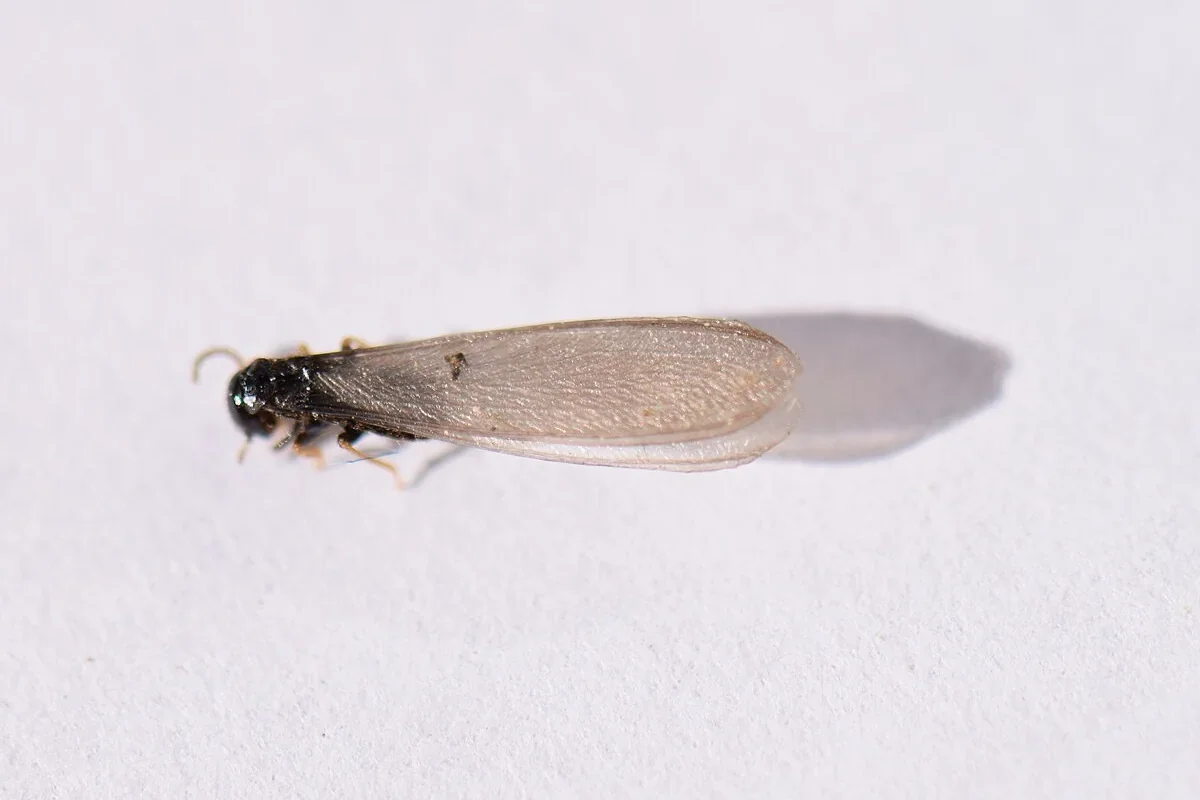
Featured photo: PumpkinSky, CC BY-SA 4.0, via Wikimedia Commons (cropped).
A cloud of winged insects pouring out of a baseboard is hard to forget. So is a pile of tiny, see-through wings on a windowsill, or a swarm rising from an old stump at the edge of the yard. All three can involve termite swarmers, but they don’t all mean the same thing for your house. This guide explains what termite swarmers are, what termite swarmers in the house usually mean, when a swarm outside deserves a closer look, and what to do in the first hour after you find them. It is general homeowner information, not an inspection or diagnosis of your home.
The Short Answer
Where you see the swarm matters more than how many insects you see:
- Swarmers coming out inside the house almost always point to an active infestation in the structure. That calls for a professional inspection.
- Swarmers next to the foundation or coming up from a porch, patio, or steps that touch the house are a strong reason to have the home checked.
- Swarmers from a stump, log, or woodpile out in the yard show termites are on the property, but they don’t by themselves prove termites are feeding on your house.
- The swarmers themselves are harmless. They don’t bite, sting, or eat wood, and indoor swarmers die within about a day. The colony that produced them is the real concern.
What Termite Swarmers Are
Swarmers, also called alates, are the winged kings and queens of a termite colony. Most of a subterranean termite colony is made up of pale, soft-bodied workers that stay hidden in the soil, in mud tubes, and inside wood. Once a colony is mature, it starts producing winged reproductives that leave all at once to pair off and start new colonies.
Warmer temperatures and rain trigger the swarmers to emerge and fly. They soon drop to the ground, shed their wings, pair with a mate, and try to start a new colony in the soil. Very few succeed, but the flight is what most homeowners notice, because it is one of the few times termites show themselves in the open.
In the Birmingham area, the swarmers you are most likely to see are eastern subterranean termites. They are about 3/8 inch long including the wings, with black or dark brown bodies and two pairs of long, light-colored wings that are equal in size. They swarm during the day. The invasive Formosan subterranean termite swarms later in the season and at night, drawn to lights. Our guide to Formosan and native subterranean termites in Alabama covers how the two compare.
When termites swarm in Alabama
Spring is the main swarm season. In Alabama, swarming peaks from April through July, though it can happen any time of year when conditions are right. Native subterranean termites usually start earlier in that window, sometimes in late winter, while Formosan swarms come in late spring and early summer. Swarming usually happens on warm, humid, calm days after a rain, typically within one to three days of it. So if you find wings on a sunny morning after a stormy spring weekend, the timing fits.
Termite Swarmers in the House: What It Usually Means
Finding termite swarmers in the house is the clearest warning sign of the two. Winged termites discovered indoors almost always indicate an infestation that warrants treatment. It takes several years for a colony to grow large enough to produce swarmers, so large numbers emerging inside a building mean a large colony is feeding on it. Killing the swarmers does nothing to that colony.
Swarmers are attracted to light, so they usually gather at windows and glass doors, even if they emerged somewhere else. Common clues include:
- Winged insects at windows, glass doors, or light fixtures, often in a room that doesn’t get much traffic.
- Small piles of identical, see-through wings on windowsills, floors, or in spider webs, sometimes with no insects left at all.
- Dead swarmers along baseboards or in window tracks. Indoor swarmers dry out and die quickly.
- A specific spot they keep coming from, such as a crack in a slab floor, a gap around a door frame, or the edge of a baseboard.
That last clue is worth writing down. Where swarmers come from is often more useful to an inspector than where they end up. Our guide to signs of termites and termite damage covers the other evidence to look for, such as mud tubes on the foundation and wood that sounds hollow.
A swarm indoors is unsettling, but it isn’t a reason to panic. Termites damage wood slowly, so taking a few days or weeks to get an inspection and make an informed decision generally makes little difference. Take the time to get a clear answer before you commit to anything.
Termite Swarmers Outside: When It Matters
A swarm outdoors tells you termites are living nearby. Whether it means your house is involved depends on where the swarm came from:
- Out in the yard. Swarms from tree stumps, woodpiles, and similar spots in the yard are not necessarily cause for concern and do not automatically mean the house is infested. A swarm from a stump or log well away from the foundation, about 25 feet or more, is rarely a cause for concern. Those termites are doing what termites do in nature: breaking down dead wood.
- Next to the house. If swarmers are emerging next to the foundation or from porches or patios that abut the house, there’s a good chance the home is infested as well. A swarm very near the foundation is definite cause for a professional inspection.
- Near the house, source unclear. An inspection is a good idea when termites are swarming around the outside of a home, because finding the source of the swarm is the key to diagnosing the problem.
Either way, an outdoor swarm is a good reminder to check the conditions that draw termites toward a house: wood touching soil, firewood or lumber stacked against the walls, mulch piled high against the foundation, clogged gutters, and plumbing or roof leaks. Our post on termite damage vs. wood rot explains why moisture problems and termites so often show up together.
Termite Swarmers or Flying Ants?
Winged ants swarm in spring too, and they are the most common mix-up. The quick differences:
- Antennae: straight on termites, bent at an elbow on ants.
- Waist: thick and uniform on termites, pinched and narrow on ants.
- Wings: two pairs of equal length on termites. Ant front wings are longer than the hind wings.
Flying ants indoors can still mean a problem, since some swarmers come from colonies nesting inside the home. If you are seeing ants rather than termites, our ant control page explains how we identify the species and find the nest. When you can’t tell which insect you have, save a few for an expert to look at.
What to Do If You Find Termite Swarmers
The first hour matters less than you might think, but a few simple steps make the inspection more useful:
- Skip the spray. Spraying swarmers kills only the insects you can see. The colony is in the soil or the structure, out of reach. Do-it-yourself termite treatment isn’t the way to handle a home infestation.
- Close off the room if the swarm is indoors. Close the door to the room where termites are swarming to keep them contained.
- Save a few. Put several swarmers in a small, sealed container or bag, or stick them to clear tape. Shed wings help too. An inspector can confirm whether they are termites or ants.
- Note where they came from. Take photos of the spot, the time, and the date before you clean up.
- Then vacuum or sweep up the rest. Indoor swarmers can’t survive long and can’t damage your home.
- Schedule a termite inspection. A licensed inspector can look for mud tubes, damaged wood, and moisture problems, and tell you whether termites are active in the structure.
How Red Mountain Pest and Termite Control Can Help
Red Mountain has served Birmingham homeowners since 2013. We are licensed, insured, and locally owned. If you have found swarmers, wings, or anything else that looks like termite activity, a termite inspection is the right first step. Our specialists check the crawl space, sill plates, foundation walls, and any wood that touches soil. We look for active signs, such as mud tubes, damaged wood, and discarded wings, along with the conditions that invite termites in, like moisture and wood-to-ground contact. You’ll get a plain-language explanation of what we found and your options.

If termites are active, we use the Sentricon termite baiting system. Stations go in the soil around your foundation, and foraging termites carry the bait back to the colony. Termite Guard, our ongoing termite control program, includes the Termite Bond, an annual inspection, and Sentricon management. Curious how baiting compares with liquid treatments? Our guide to termite baits vs. liquid treatments walks through the tradeoffs. You can also compare year-round options, including the 365 Bundle, on our service plans page. We do not repair termite damage. If repairs are needed, you’ll need a qualified contractor.
Whether you live in Mountain Brook, Homewood, Vestavia Hills, or elsewhere around Birmingham, if you have found termite swarmers in the house or near your foundation, call Red Mountain Pest and Termite Control at (205) 637-3260 or request a free quote. Tell us where you saw them and when, and we will help you figure out the next step.
Frequently Asked Questions
Do termite swarmers in the house mean I have termites?
Usually, yes. Swarmers emerging inside a home almost always mean a colony is feeding in or under the structure. One exception: in areas with heavy Formosan termite activity, a few Formosan swarmers can fly in toward lights at night without the building being infested. Saving a sample and having it identified helps sort that out.
Do termite swarmers damage wood?
No. Swarmers don’t eat wood, bite, or sting. The damage comes from the workers in the colony that produced them, which usually stay out of sight.
Will termite swarmers go away on their own?
The swarmers will. Indoor swarmers die within about a day, and a swarm is usually over quickly. The colony that sent them out does not go away, so the swarm ending doesn’t mean the problem is solved.
When do termites swarm in Alabama?
Mostly in spring. In Alabama, swarming peaks from April through July, often one to three warm, calm days after a rain. Native subterranean termites swarm during the day and can start in late winter. Formosan termites swarm at night in late spring and early summer.
Should I spray termite swarmers?
There’s no need. Spraying kills only the insects you can see and does nothing to the colony. Vacuum them up after you have saved a few for identification, then schedule an inspection.
Is a termite swarm outside my house a problem?
It depends on where it starts. A swarm from a stump or woodpile out in the yard doesn’t automatically mean your house is infested. Swarmers coming up next to the foundation or from a porch or patio that touches the house are a good reason to have the home inspected.
Featured photo: Eastern subterranean termite swarmer (Reticulitermes flavipes). Photo by PumpkinSky, CC BY-SA 4.0, via Wikimedia Commons. Cropped.