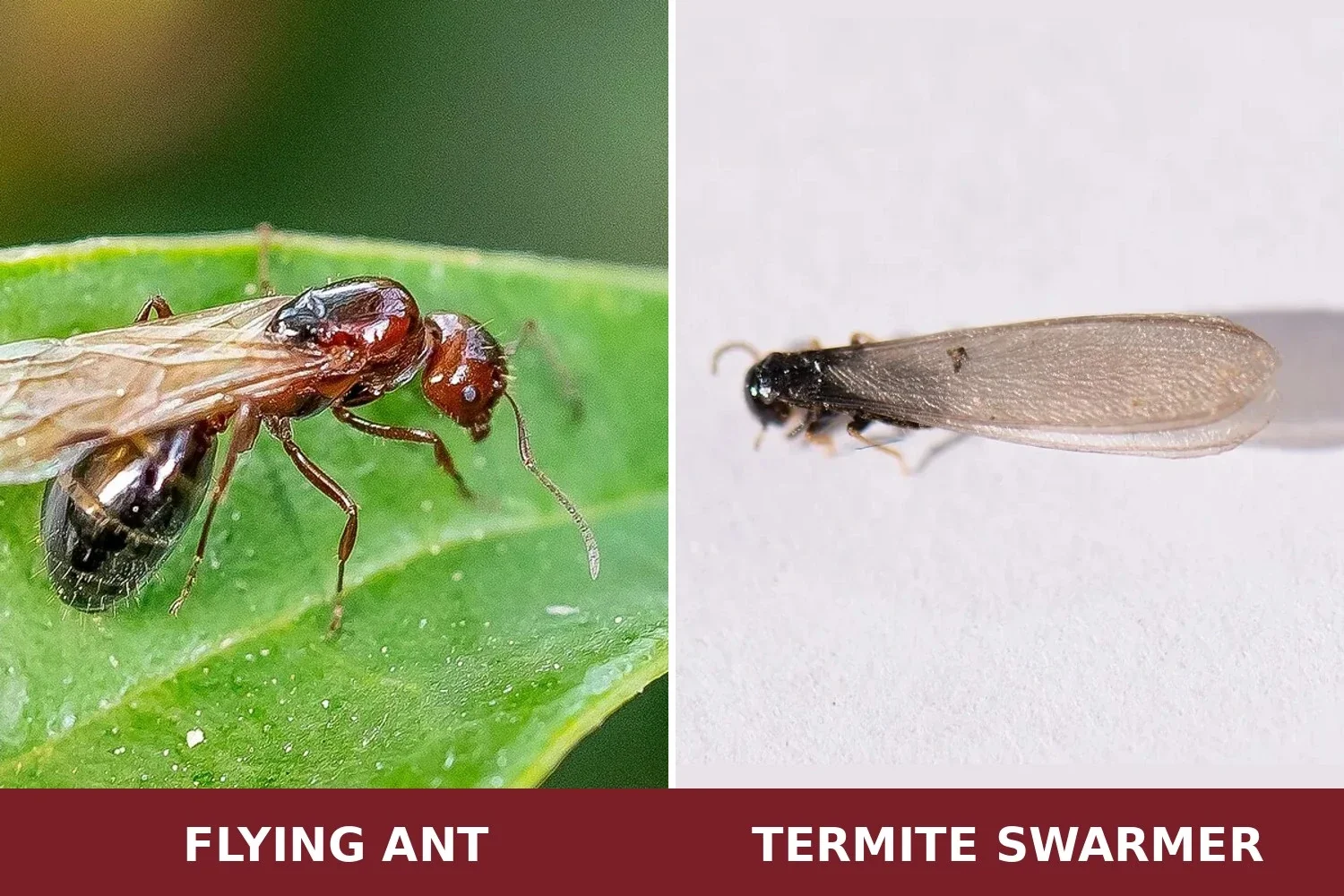
Photos: winged carpenter ant by Esin Üstün (CC BY 2.0); termite swarmer by PumpkinSky (CC BY-SA 4.0), via Wikimedia Commons. Cropped and combined; this composite is licensed CC BY-SA 4.0.
A handful of winged insects on a windowsill raises one question fast: are these flying ants or termites? The answer matters, because the two point to very different problems and next steps. You don’t need a microscope to tell them apart. Three body features, plus a few clues about timing and what gets left behind, will usually settle it. This guide walks through each difference, what each insect can mean for your home, and what to do if you still aren’t sure. It is general homeowner information, not an inspection or diagnosis of your home.
The Short Answer
Look closely at one insect, ideally with a magnifying glass or a zoomed-in phone photo:
- Antennae: bent at an elbow on ants; straight and bead-like on termites.
- Waist: pinched and narrow on ants; thick and uniform on termites, with no visible waist at all.
- Wings: two pairs on both, but ant front wings are noticeably longer than the hind wings. Termite wings are all the same length and reach well past the end of the body.
- Left-behind wings: a pile of identical, see-through wings points toward termites. Both insects shed their wings, so wings alone are a clue, not proof.
Flying Ants or Termites: Three Body Clues to Check
Winged ants and termite swarmers are both the reproductive members of their colonies, leaving the nest all at once to mate and start new colonies. That shared behavior is what makes them so easy to confuse. Their bodies, though, are built differently.
Antennae: elbowed or straight
Ant antennae have a distinct bend partway along, a bit like an arm bent at the elbow. Termite antennae are straight and look like a short string of tiny beads. On a phone photo, this is often the easiest feature to see.
Waist: pinched or thick
Ants have a narrow, pinched waist between the middle of the body and the abdomen, much like a wasp. Termites have no pinch at all. The body is broad and the abdomen joins the rest of the body along its full width, so a termite swarmer looks thick and evenly shaped from front to back.
Wings: two sizes or one
Both insects have two pairs of wings, but they are built differently. On a winged ant, the front pair is clearly longer and larger than the hind pair. On a termite swarmer, all four wings are about the same size and shape. Termite wings are also long for the insect, roughly twice the length of the body, so they extend well past the tip of the abdomen and lie flat over the back like a narrow, milky-gray cloak.
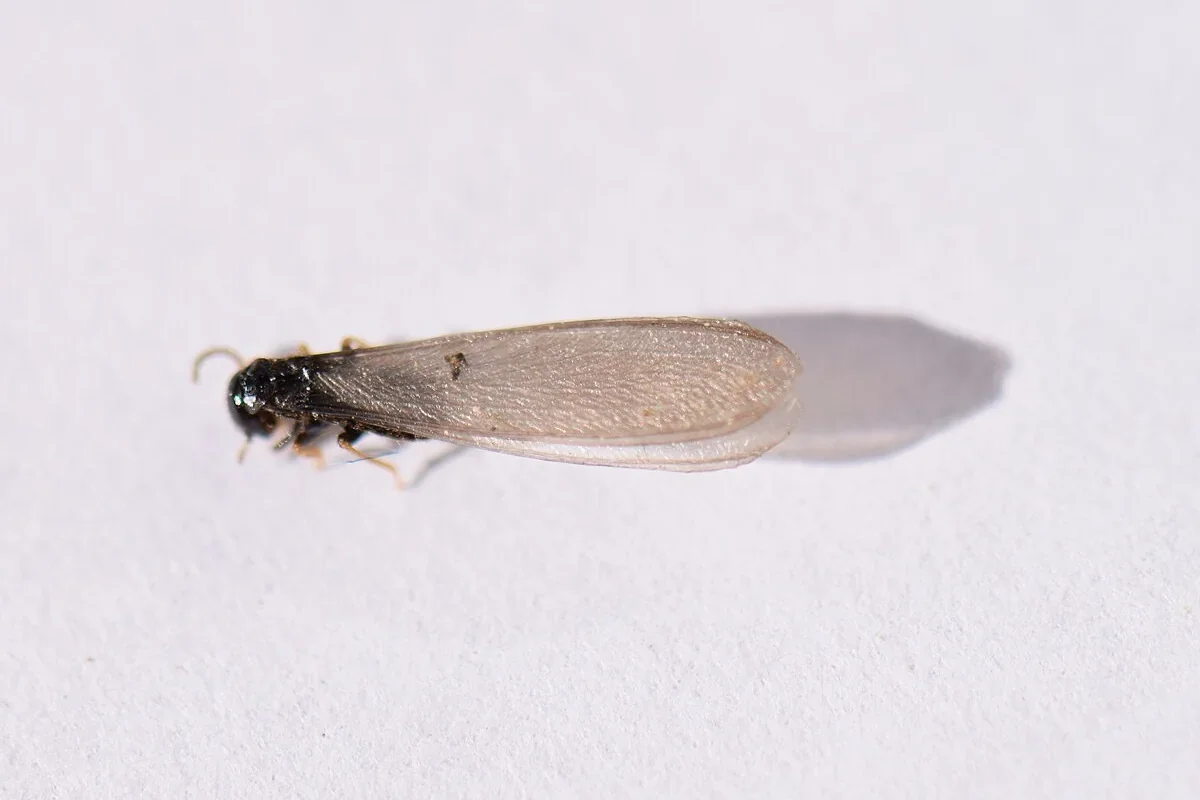
Termite swarmer: straight antennae, no pinched waist, and long wings of equal length. Photo: PumpkinSky, CC BY-SA 4.0, via Wikimedia Commons. Cropped.
Shed Wings: What Gets Left Behind
Many homeowners never see the insects, only the wings left on a windowsill, a floor, or in a spider web. Both termites and ants drop their wings soon after swarming, so the wings are useful evidence.
- Termite wings are all the same size and shape, long, narrow, and see-through or milky. A pile of them looks uniform.
- Ant wings come in two sizes, larger front wings and smaller hind wings.
A pile of identical wings near a window is one of the classic signs that termites have swarmed indoors. Our guide to signs of termites and termite damage covers the other evidence that tends to show up with it, such as mud tubes on the foundation.
What Doesn’t Help: Color and Size
It’s natural to judge by color, but it can lead you astray. The swarmers of our native eastern subterranean termites are dark brown to black, about 3/8 inch long including the wings. Formosan termite swarmers are lighter, tan to yellowish brown, and a bit larger. Winged ants range from pale tan to reddish to black depending on the species, and many are about the same size as a termite swarmer. A dark insect with wings could be either one.
Behavior doesn’t help much either. Both are drawn to light and gather at windows and glass doors, so stick with the body clues above.
Timing Clues: When Ants and Termites Swarm
Around Birmingham, spring is busy season for both. Native subterranean termites swarm during the day, usually on warm, humid, calm days after a rain. Their season can begin in late winter and runs through spring into early summer. Formosan termites swarm later, mostly in late spring and early summer, and they fly at night, gathering around porch lights and lit windows.
Ants are less predictable. Carpenter ants typically swarm in spring. Many other ant species fly later, from late spring through summer and into fall, often after a rain. Timing can nudge you one way, but it can’t settle the question. A winged insect in the middle of winter, flying inside a heated home, deserves attention whichever it turns out to be, because it suggests the colony is living indoors.
For more on termite swarm season and what indoor and outdoor swarms each mean, see our guide to termite swarmers indoors and outdoors.
What Each One Means for Your Home
If they are termite swarmers
Termite swarmers coming out inside a home almost always mean a colony is feeding in or under the structure. It takes several years for a colony to grow big enough to produce swarmers, so their appearance points to an established colony, not a brand-new one. The swarmers themselves are harmless. They don’t bite, sting, or eat wood, and indoor swarmers die quickly. The concern is the colony of workers that produced them, which stays hidden in the soil and inside wood.
A swarm from a stump or woodpile out in the yard doesn’t by itself prove your house is involved, but swarmers right beside the foundation are a strong reason to have the home checked. Either way, a professional termite inspection is how you get a clear answer.
If they are flying ants
Flying ants outdoors are a normal part of the season and often mean nothing more than a colony nesting in the yard. Flying ants inside the house are worth a closer look. Swarmers emerging indoors, especially repeatedly from the same wall, window frame, or baseboard, can mean a colony is nesting inside the structure rather than just wandering in. The species matters, so identifying it comes first. Our ant control page explains how we identify the ant and treat the colony at its nest.
Carpenter ants: the ant to take seriously
Carpenter ants are the ants most likely to damage wood in a home. They are large ants, roughly 3/8 to 1/2 inch long for workers, with queens larger still, and they are usually black or red and black. Unlike termites, carpenter ants don’t eat wood. They hollow it out to make room for their nest, and they strongly prefer wood that is already damp or softened by leaks.
A few clues help separate carpenter ant activity from termites:
- Debris: carpenter ants push out small piles of coarse, sawdust-like shavings, sometimes mixed with insect parts, beneath the wood they are working in. Subterranean termites don’t leave sawdust piles.
- Galleries: carpenter ant tunnels are smooth and clean, almost sanded. Termite-damaged wood is hollowed along the grain with bits of dried mud or soil lining the galleries.
- Moisture: carpenter ants indoors often lead back to a roof leak, a plumbing leak, or wood that stays wet.
Large numbers of winged carpenter ants indoors suggest the nest is inside the home. Our post on termite damage vs. wood rot goes deeper into how carpenter ant damage, termite damage, and decay each look.
Still Not Sure? What to Do Next
If you can’t tell which insect you have, these steps make identification faster:
- Save a few. Put several of the insects in a small sealed container or bag, or press them onto clear tape. Shed wings are worth saving too.
- Take close-up photos. Try to capture the antennae, the waist, and the wings, with a coin or ruler in the frame for size.
- Note where they came from. Write down the room, the spot they seemed to emerge from, the date, and the time of day.
- Skip the spray. Spraying winged insects kills only the ones you can see. It doesn’t reach a termite colony or an ant nest in a wall.
- Clean up, then call. Once you have samples and photos, vacuum or sweep up the rest and schedule an inspection.
How Red Mountain Pest and Termite Control Can Help
Red Mountain has served Birmingham homeowners since 2013. We are licensed, insured, and locally owned.
If there’s any chance you’re dealing with termites, a termite inspection is the right first step. Our specialists check the crawl space, sill plates, foundation walls, and any wood that touches soil, looking for mud tubes, damaged wood, discarded wings, and the moisture problems that draw termites in. You’ll get a plain-language explanation of what we found and your options. If termites are active, we use the Sentricon termite baiting system, and Termite Guard, our ongoing termite control program, includes the Termite Bond, an annual inspection, and Sentricon management. We do not repair termite damage. If repairs are needed, you’ll need a qualified contractor.
If the insects turn out to be ants, our technicians identify the species and follow the trail back to the nest. Ant control is part of our quarterly general pest plan, and you can compare year-round options, including the 365 Bundle, on our service plans page.
Whether you live in Mountain Brook, Homewood, Vestavia Hills, or elsewhere around Birmingham, if you’re wondering whether you’ve got flying ants or termites, call Red Mountain Pest and Termite Control at (205) 637-3260 or request a free quote. Tell us what you found and where, and we’ll help you figure out the next step.
Frequently Asked Questions
How can I tell if I have flying ants or termites?
Check three things on a single insect: the antennae, the waist, and the wings. Ants have elbowed antennae, a pinched waist, and front wings longer than the hind wings. Termites have straight, bead-like antennae, a thick body with no waist, and four wings of equal length that extend well past the body.
Do flying ants mean I have termites?
Not by themselves. Flying ants are ants, not termites, so seeing them tells you nothing either way about termites. They swarm at similar times of year, which is why the two get mixed up. If you find winged insects indoors and aren’t sure which they are, save a few for identification.
Are flying ants a problem if they’re inside the house?
They can be. Winged ants emerging indoors, especially again and again from the same spot, can mean a colony is nesting inside the home. Large ants that are black or red and black may be carpenter ants, which nest in wood and are worth having checked.
Do flying ants lose their wings like termites?
Yes. Both drop their wings soon after swarming. The difference is in the wings left behind: termite wings are all the same size, while ant wings come in two sizes, with the front pair larger than the hind pair.
Can carpenter ants damage my house like termites?
They can damage wood, but in a different way. Carpenter ants hollow out wood to nest and don’t eat it, and they favor wood that is already damp or decayed. Termites eat wood and can cause more extensive damage over time. Both are worth a professional look if you see signs of them indoors.