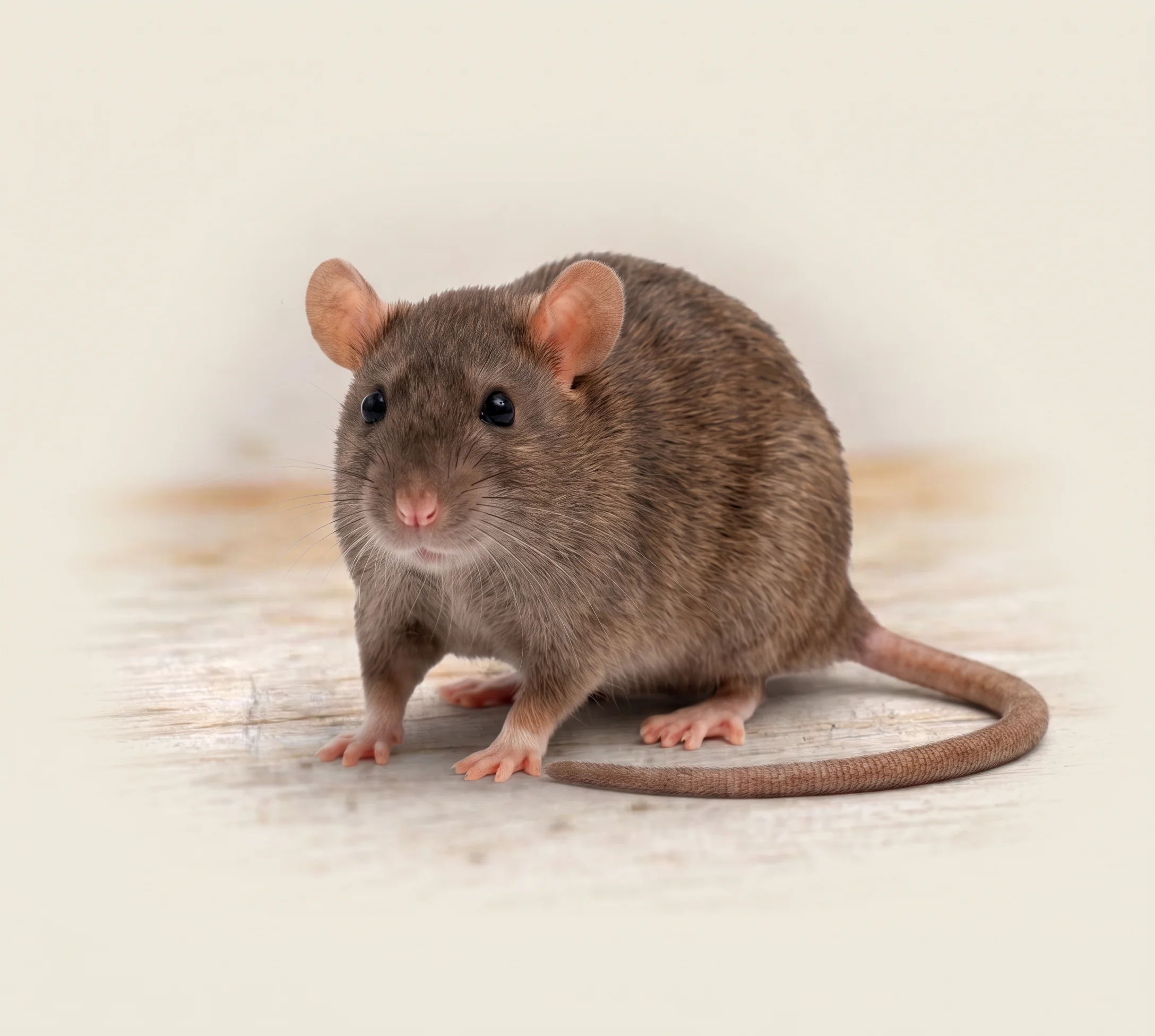
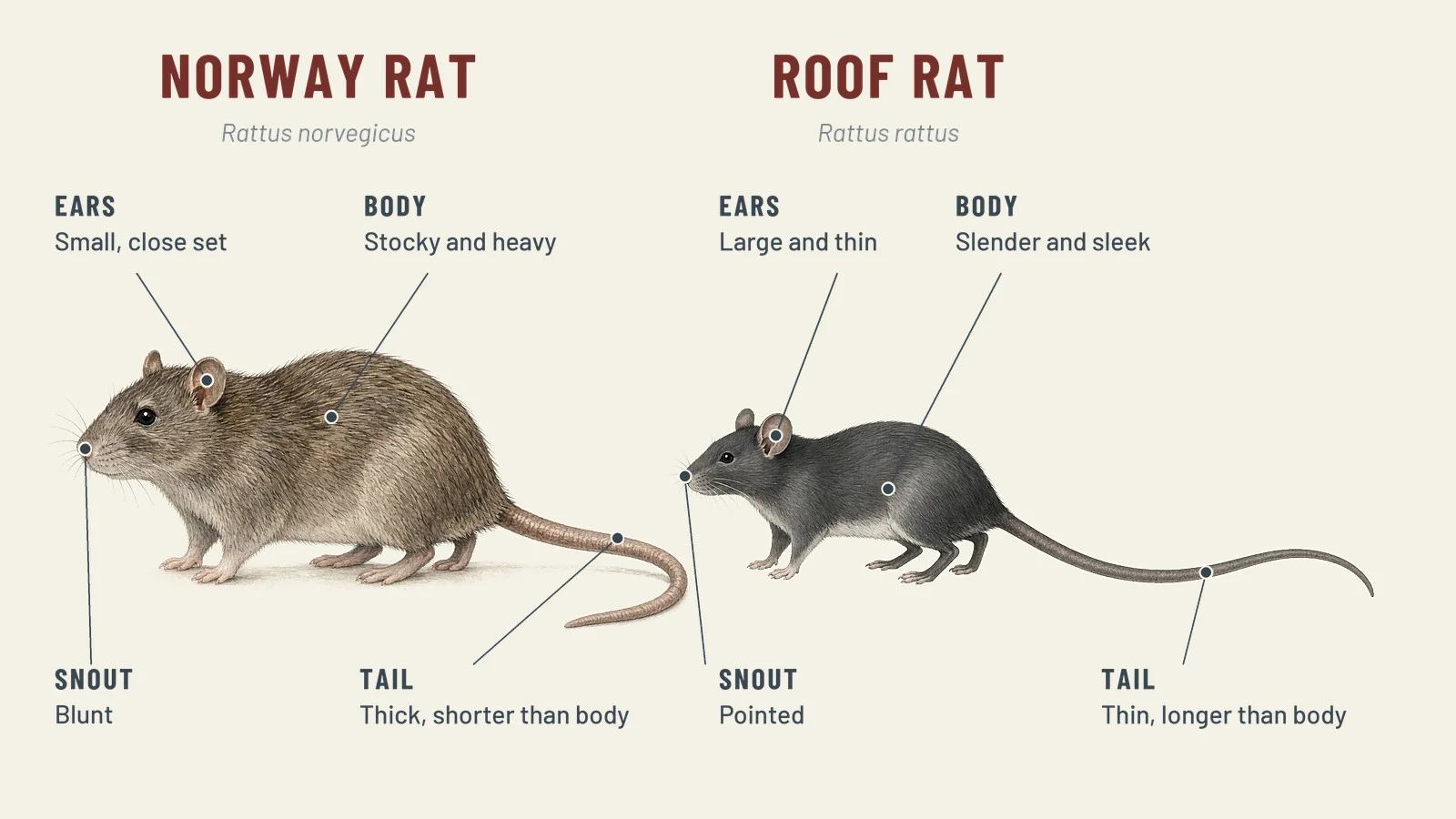
Roof rats and Norway rats are the two rats most likely to show up in and around homes, and they are easier to tell apart than many people think. A roof rat is the sleeker of the two, with a pointed nose, large ears, and a tail longer than its head and body combined. It climbs well and tends to stay up high, in trees, vines, attics, and upper walls. A Norway rat is heavier and stockier, with a blunt nose, small ears, and a shorter tail. It burrows and usually stays low, around foundations, crawl spaces, garages, and ground floors. When you never see the animal, where the signs show up and the shape of the droppings can still point you in the right direction. This guide covers those clues. It is educational, not a diagnosis of your home.
The Short Version: Roof Rat vs. Norway Rat
Clues that point toward a roof rat:
- A slender, agile body with a pointed muzzle
- Large ears and eyes
- A tail that is longer than the head and body
- Activity up high: attics, rafters, upper walls, fence tops, tree limbs, and utility lines
- Droppings with pointed ends
Clues that point toward a Norway rat:
- A heavy, thick body with a blunt nose
- Small ears and eyes
- A tail that is shorter than the head and body
- Activity down low: burrows along the foundation, under slabs, woodpiles, or debris, plus crawl spaces and ground floors
- Larger droppings with blunt, rounded ends
No single clue settles it, and both rats can turn up in the same building. Look at several clues together.
How to Tell Them Apart by Appearance
Alabama Cooperative Extension names the Norway rat and the roof rat as the two rats most often causing problems around homes. If you get a good look or a clear photo, these features help separate them.
Body size and build
Norway rats are the bigger, bulkier rat. Alabama Extension puts an average adult at about a pound, while the University of California IPM program lists adult Norway rats at about 7 to 18 ounces and roof rats at about 5 to 10 ounces. A Norway rat looks thick and heavy; a roof rat looks lighter and more graceful.
Nose, ears, and eyes
The face is one of the most useful clues. A roof rat has a pointed muzzle and large ears and eyes. A Norway rat has a blunt nose and smaller ears and eyes. UC IPM notes that a roof rat’s ears are long enough to reach its eyes when folded forward, while a Norway rat’s ears are not.
The tail test
Tail length is the classic tie-breaker. A roof rat’s tail is longer than its head and body combined, and it is uniformly dark. A Norway rat’s tail is shorter than its head and body, and it is usually darker on top and paler underneath. Both tails are scaly and mostly hairless.
Please do not handle a live rat to check. Rats can bite and carry germs. If you find a dead one, wear gloves, take a photo next to something for scale, and let a professional take a look.
Why color is a weak clue
Roof rats are also called black rats, and Norway rats are often called brown rats, but those nicknames can mislead. Color alone is not a dependable way to identify a rat. Body shape, nose, ears, and tail tell you more.
Where Each Rat Tends to Live and Travel
Behavior often gives a rat away before you ever see it. Alabama Extension sums it up this way: in general, Norway rats are troublesome close to the ground, while roof rats live up in the rafters.
Roof rats: climbers that live up high
As the name suggests, roof rats are excellent climbers. They often live in trees, dense shrubs, and vine-covered fences, and they may enter buildings from the roof or along utility lines. Indoors, they tend to nest in attics, wall voids, ceiling voids, and cabinets. UC IPM notes they are often seen at night running along overhead lines or fence tops, and that they favor fruit, nuts, and berries.
Norway rats: burrowers that stay low
Norway rats dig. They make burrows along foundations, under concrete slabs, beneath woodpiles and trash, and around gardens, often with a main entrance and one or more escape holes. They can climb, but when they move indoors they usually stay in crawl spaces, basements, garages, and ground floors. When both species share a building, Norway rats typically stay on the lower levels and roof rats on the upper levels.
Clues When You Never See the Rat
Most people find signs long before they see a rat. These clues help narrow it down:
- Droppings. Rat droppings are roughly 1/2 to 3/4 inch long, much bigger than a mouse’s. NC State Extension notes that Norway rat droppings tend to have rounded ends, while roof rat droppings tend to be pointier. Fresh droppings are dark and soft; older ones fade and crumble.
- Where the signs are. Droppings and gnawing in the attic, on rafters, or on top of cabinets point up, toward roof rats. Signs in the crawl space, along the foundation, or in the garage point down, toward Norway rats.
- Burrows. Holes in the soil along the foundation, under slabs, or beneath woodpiles are more typical of Norway rats.
- Rub marks. Dark, greasy smudges along beams, pipes, and walls show repeated travel routes. On rafters and high beams, they suggest a climber.
- Gnawing. Both rats gnaw wood, plastic, and wiring insulation. Fresh chewing is a reason to act sooner.
If you are mostly hearing noises in the attic or walls, our guide to recognizing rodent activity in the attic or walls covers sounds, timing, and how to tell rodents from squirrels and other wildlife.
Is It a Rat or a Mouse?
First, rule out a house mouse. An adult house mouse usually weighs less than an ounce, and its droppings are tiny, about the size of a grain of rice. A young rat can be small too, but Alabama Extension notes that young rats have large heads and feet compared to their bodies, while mice have small heads and feet. Large droppings are a strong sign you are dealing with a rat.
If the evidence points to a squirrel, raccoon, bat, or other wildlife, that is a job for a wildlife specialist. Our rodent work focuses on mice and rats.
Why the Difference Matters
Knowing which rat you have changes where you look and what you do. UC IPM stresses that it is important to know which species is present to choose effective control strategies.
- Entry points. Roof rats often get in up high, around rooflines, eaves, vents, and spots where tree limbs or utility lines touch the house. Norway rats more often get in low, through foundation gaps, utility penetrations, and crawl space openings.
- Trap and station placement. Extension guidance places traps for roof rats along beams, rafters, ledges, and other overhead travel routes, and traps for Norway rats close to walls, in dark corners, and near burrows.
- Patience. Rats avoid new objects and foods at first, so traps and stations may be ignored for days. UC IPM notes this wariness is thought to be stronger in roof rats.
What You Can Do Right Now
- Photograph droppings, gnaw marks, rub marks, and burrows, with a coin for scale.
- Note where the signs are: attic, upper walls, kitchen, garage, crawl space, or along the foundation.
- Secure food: store pet food and bird seed in sealed containers, keep trash lids closed, and pick up fallen fruit and nuts.
- Look for easy routes: tree limbs over the roof, vines on walls or fences, and gaps around pipes and vents.
- Do not sweep or vacuum droppings or nests. That can stir particles into the air. Our attic guide walks through the CDC’s safer cleanup steps.
- Do not seal openings while rats may still be inside, and use any store-bought bait only according to the label and away from children and pets.
How Red Mountain Pest & Termite Can Help
Whichever rat you suspect, the first step is the same: confirm what is there and how it is getting in.

Our mice and rat infestation control starts by identifying whether you have mice, rats, or both. We locate nests and runways during a Property 360 walkthrough, then place traps and tamper-resistant bait stations where the activity is and come back for follow-up to reset, verify, and adjust. To keep new rats from replacing the ones removed, our rodent exclusion service seals the gaps, vents, and utility penetrations they use, from the foundation to the roofline. Exclusion is quoted to your home after the walkthrough. For ongoing protection, our quarterly pest plan includes perimeter rodent baiting at every visit, and you can compare options, including the 365 Bundle, on our service plans page. You can see everything we do for rodents on our rodent control page.
If you have found droppings, gnaw marks, or a rat and are not sure what you are dealing with, call Red Mountain Pest & Termite at 205-637-3260 or request a free quote. Tell us what you found and where, and we will help you figure out the next step for your home around Birmingham.
Frequently Asked Questions
What is the easiest way to tell a roof rat from a Norway rat?
Look at the tail and the face. A roof rat has a tail longer than its head and body, a pointed nose, and large ears. A Norway rat has a shorter tail, a blunt nose, small ears, and a heavier body. Where you find the signs helps too: up high suggests roof rats, and down low suggests Norway rats.
Are roof rats found in Alabama?
Yes. Alabama Cooperative Extension covers both roof rats and Norway rats in its guide to controlling rats around the home. Which one you have depends on the property, so check the clues rather than assuming.
Can Norway rats get into an attic?
They can. Norway rats climb, even though they usually stay low. Roof rats are the more likely attic rat, but location alone does not prove the species.
Does a brown rat mean it is a Norway rat?
Not necessarily. Color is a weak clue. Use body build, nose shape, ear size, and tail length instead.
Why won’t rats go near my traps?
Rats are wary of new objects and often avoid traps and bait for days at first. Placement matters as much as the trap: overhead routes for roof rats, along walls and near burrows for Norway rats. If activity continues, a professional inspection can help.